Grand Junction
The Dog StarsGrand Junction is a regional city and airport that becomes the destination of a flight, a vision of the pandemic’s devastation, and the site of a concealed runway trap. Its significance lies in the dissonance between the ruined town below and the airport’s apparently functioning lights and radio: what first seems to promise contact and refuge instead signals danger.
City and Surrounding Landscape
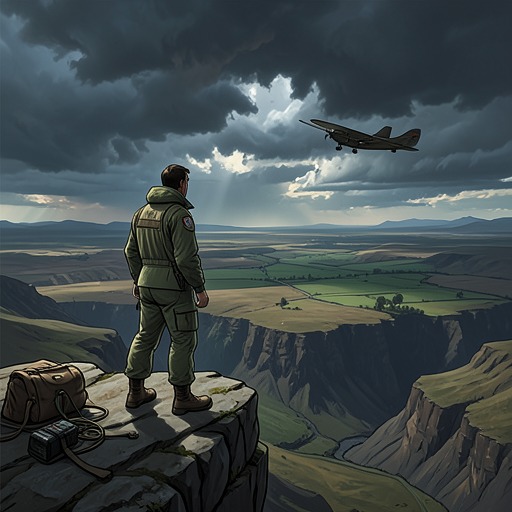
Seen from the air, Grand Junction stretches across desert hills between two rivers, reaching north toward the Book Cliffs. Its broad civic geography remains legible: highways, residential streets and cul-de-sacs, big-box stores, parking lots, rail lines, warehouses, and an industrial district along the Colorado River. Cottonwoods still mark streets and river parks, but drought has killed many of the trees; those with deeper roots survive in scattered patches, sometimes only partly leafed. Greenery persists, but as fragments within a damaged landscape rather than evidence of recovery.
The city’s ruin is widespread. Cars are scorched across streets, parking lots, and highways, and entire neighborhoods have burned. Other structures appear to have been damaged by fire without being completely destroyed. Human remains are visible from the air, making the scale of the catastrophe impossible to reduce to abandoned buildings or ordinary urban decay. The devastation appears to have reached every part of town. For Hig, who has spent years observing the post-collapse world from the air, Grand Junction is not merely another wrecked settlement: it is a place where the destruction that has defined his daily experience becomes visible as a whole city.
The City in Memory
Grand Junction also has a specific place in Cima and Pops’s earlier life. They used it for major shopping, including trips for groceries and supplies, vehicle parts, and farm equipment. They also went there for weekend movies when the local offering in Delta did not interest them. The two towns were nearly equidistant from their ranch, making Grand Junction part of an ordinary regional routine before the collapse.
Cima and Pops left the ranch as the crisis intensified, before they had witnessed the full extent of the social breakdown. Their departure came while television news still reported events, though its broadcasts grew increasingly strained as presenters and correspondents disappeared into hospitals, makeshift flu wards, or from public view. The flight over Grand Junction therefore gives Cima a view of the fate of a place she remembers as accessible and familiar, but had not seen after the collapse. Her distress on seeing the city reflects that gap: leaving before the worst had protected her from witnessing its end, but it had not spared her the later knowledge of what became of it.
Hig understands that the city’s condition also confirms the decision Cima and Pops made to flee. Yet confirmation brings no uncomplicated comfort. Their choice was made amid danger, and Grand Junction displays what they escaped; the same evidence that vindicates their departure makes the cost of that escape difficult to ignore. The town is thus both a lost part of their former world and a record of the survival decision that carried them away from it.
The Airport and the Promise of Contact
Grand Junction enters Hig’s plans through a radio transmission from its airport tower. The call, received three years before the flight, gives the destination a special status: it is evidence that someone may still be operating an airfield and able to communicate. When conditions at the canyon settlement worsen and departure becomes necessary, Hig’s return to that signal is not an abstract search for news. It is an attempt to reach a place whose voice has persisted across years of uncertainty.
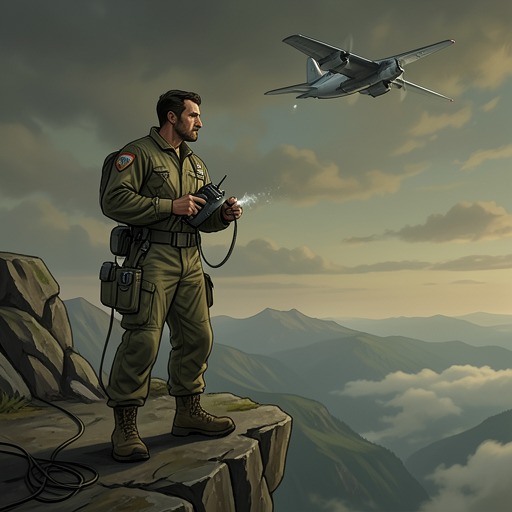
On the approach, Hig flies low to conserve fuel and passes Grand Mesa before reaching the city. He calls the tower using the frequency stored in his GPS. A woman responds with a formal clearance for a straight-in approach to runway 29, using the customary language of routine airport operations. The exchange briefly makes the old system seem intact: a pilot calls in, a controller answers, and an aircraft is directed toward a runway. The contrast between that orderly procedure and the city’s destruction affects Hig deeply. For a moment, the familiar protocol offers the possibility of returning not only to an airport but to a life before the collapse.
The airport reinforces that impression. Its long east-west runway appears smooth and maintained, and the rotating beacon is visibly operating in clear daylight. Hig initially reads the beacon and the tower’s transmission as signs of a functioning enterprise. That interpretation is plausible within the world of the story: at other airports, including the one Hig shares with Bangley, solar and wind systems help sustain basic operations. Grand Junction’s airport also has solar panels on the roof of the Jet Center, with power available for water, fuel systems, radios, and the beacon. The presence of working infrastructure does not, however, establish that the airport is safe.
The Runway Trap and Its Aftermath
As the aircraft descends, the apparent welcome reverses. The runway contains wrecked, scorched aircraft, visibly different from planes that have simply been battered loose by weather. Recognizing the pattern as evidence of crashes, Hig aborts the landing: he pulls up, applies full throttle, and climbs away instead of touching down. A cable, set taut across the approach, passes just below the aircraft. The apparent landing clearance has brought Hig, Cima, Pops, and the lambs directly toward a trap.
The escape leaves them with little fuel and no secure place on the runway. Hig taxis to cover beside Big River Flight School and Authorized Cessna Service Center, stopping close enough to the building that those in the tower cannot easily see or aim at the aircraft. Cima remains shaken by both the deception and the sight of the city; the danger cannot be separated from what Grand Junction represents to her. Pops and Hig must treat the airport not as a reliable point of contact but as a hostile location whose radio procedures and visible equipment may conceal an ambush.
The airport’s power supply makes the deception materially possible. Solar panels on the Jet Center roof could support the pumps, radios, and beacon, while the nearby fuel pumps represent both a useful resource and a vulnerable point. From the aircraft, Hig considers how survivors could have been targeted from a distance or drawn toward the tower by someone appearing to offer help. The narration presents those possibilities as Hig’s reconstruction rather than a fully established account of every action taken at the airport. The tower’s polished routine and the maintained runway are therefore not proof of safety; they are part of the uncertainty that turns Grand Junction into a place where familiar infrastructure can serve as bait.
Grand Junction’s role joins two kinds of aftermath. The city’s burned neighborhoods and surviving pockets of green register the collapse across civilian life, while the airport condenses the dangers facing survivors who still depend on radios, fuel, navigation, and aircraft. The signal that once encouraged Hig to hope for useful news leads instead to an attempted landing he must escape. Grand Junction remains a recognizable place, with parks, shops, roads, and an airport, but each remnant carries a changed meaning: familiar geography can orient a traveler, and familiar procedures can still conceal lethal intent.